


Abstract
Process Control enables automatic accurate adjustment of values. Many of these values are continuously controlled in time (for example: changing heating power to adjust temperature to a set value) while others are batch process (for example: filling sugar in a box to a set weight).
The most common control process in the market is PID and its abbreviations, which works well for many continuous processes. Some continuous processes are more difficult to stabilize with PID because of changing parameters and some are impossible (for example: stabilizing a pencil on the tip of a finger). Over the years more advanced controllers have evolved like Fussy-Logic, complex polynomial controllers, Neural-Networks and many more. All of these are trying to find one good answer to many different problems. None of these is tailored for one answer and none of these is good for the batch processes. In attempt to tune and judge a control process, some measures have been declared but none of which is trying to get to the absolute allowable limits of accuracy and stabilizing speed.
Modeling
Modeling solves the control process by finding the “inverse” of the process formula (for example: it can stabilize two pencils one on top of the other on a finger).
Two types of Modeling are used: experimental and physical. The experimental method uses several system tests to find the proper “inverse” while physical calculates the inverse using physics rules. Both types are suitable for continuous and for batch processes.
Most surprisingly, this control method does not require special computers or “number-crunchers”. Most PLC’s on the market can be used so solve them efficiently.
All Sysmetric products use the physical modeling technique to get as accurate and as fast as possible to the set value, realized on standard industrial PLC.
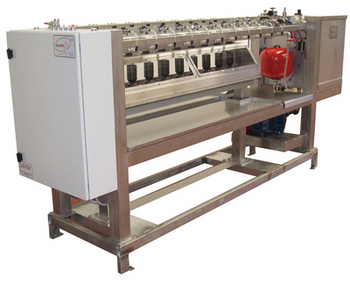
CD Batch dosing systems:
The different batch ingredients are delivered into a single weighing bucket one by one. Materials have to be delivered fast and accurately as possible.
Since materials are flying into the bucket there is some delay in the reading of their mass thus accuracy might be affected. Sometimes the set value is so small that once the first material particle is measured, the “in-flight material” contains more than the set value.
The Modeling controller solves the whole control problem with a single formula that can deliver any amount and tune itself to any material behavior.
Extruder production rate control:
The rate of production is either measured by loss-in-weight principle or by the batch dosing (mentioned above) process. These, like any other “sensors” produce a lot of noise that has to be filtered out, in order to get precise control. The filter adds delay that slows down the control process. At the end of any control action, the system has to delay its next step until the filter has stabilized. Sysmetric modeling enables continuous analysis during any ramping including special non-linear analysis for the cabling industry. This means that while extruder is ramping, it follows the require curve with a maximum error of 3% during 15 seconds ramp from 10% to 100% of production.
Internal Bubble Cooling control:
This is a typical modeling problem since there are a lot of the side affect to any action that comes sometimes many minutes after any change. Modeling sees this as a single and smooth operation, predicting any affect, making sure that the system stabilizes even before the sensors can show it.
Same goes for material feeders (screw, belt and vibrator) and to the profile control system.
Gilad Gozani

Chief Engineer
Sysmetric